
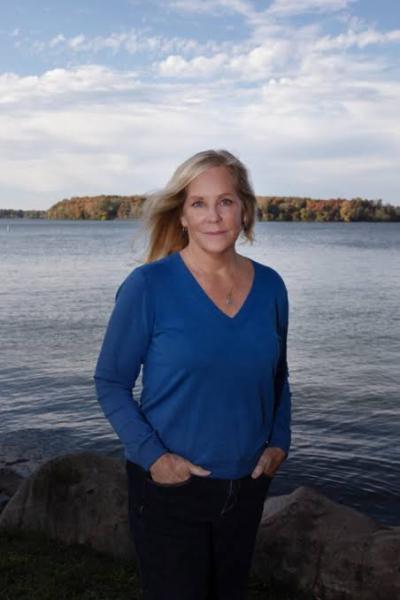
In Which a Librarian asks a Talented Author a Small Number of Questions:
Sally Cole-Misch is a writer, author and environmental communicator who advocates for the natural world through work and play. In her award-winning (and a Great Lakes Great Read) The Best Part of Us, Sally Cole-Misch ties readers to Great Lakes roots, charting the story of a young girl torn between her natural history and urban realities. Let's learn a bit more about her:
If you were a dewey number, what would you consider yourself to be?
Some combination of 810s (fiction), 796 (outdoor sports), and 577 (ecology).
If you were to come back as an animal (or anything), what would it be and why?
Part of me would hope to be a dog, since they are such angels of love, but I'm going to choose a hummingbird -- to be so small, fast and powerful and to see so much of the world from above seems like a magical life.
Do you find fiction writing easier or harder than nonfiction (or factual writings)?
I was a journalist first, so the established research process to write a news story is most comfortable for me. Switching to Great Lakes and environmental communications allowed me to use those skills in new and creative ways while still maintaining a factual basis. In my late 50s, when I wanted to learn how to write fiction that helps readers consider the value of nature, place and family in their lives, I focused again on research by completing Stanford University's three-year online fiction master's program. Intensive semesters learning about plot, characterization, voice and dialogue were difficult but an exciting renewal of my love for writing. The research I completed for the novel was a safe place to return to whenever my confidence in writing fiction waned or I wasn't sure why a character was sending the story in a new or different direction.
What books are on your "To Be Read" pile or the one on your nightstand?
I tend to keep three to four fiction and non-fiction books on my TBR pile at any time. Current fiction includes The Wild Dark Shore (Charlotte McConaghy's latest, which I'm reading for a rare second time), Floreana by Midge Raymond, and I recently finished the amazing Playground by Richard Powers. Non-fiction includes The Language of Climate Politics: Fossil-Fuel Propaganda and How to Fight It by Genevieve Guenther and Planet Aqua by Jeremy Rifkin. Two books are always on my nightstand: An Immense World by Ed Yong, which I reach for when I can't sleep, and Devotions by Mary Oliver. I try to read one of her magnificent poems in the morning before I start my day.
What inspires you when writing? Is there one particular thing or when you get stuck, what helps you get back on track? Being in nature, hiking, talking it out, the smell of cut grass? (a writer mentioned cut grass to me once and I thought that was interesting, it has a great smell for the senses!)
My inspiration to write The Best Part of Us and my career in environmental communications has always been the natural world. Forty years ago, we thought we had to hammer home all the horrible things we were doing to the planet in our writing. But thousands of studies over the past 20 years have reinforced the simple truth that people act to protect what they value. To realize the natural world's value in our lives, we simply need to be in it and nature will do the rest: take a walk in the woods and absorb the trees' gifts of phytoncides, which elevate our immune and cognitive abilities and reduce stress; hike in the mountains or relax by moving water and breathe in the negative ions they release, which act as natural antidepressants and increase our sense of generosity. Even just a walk around my neighborhood, looking at the treetops in sun or snow, can refocus my thoughts for writing.
Those are some fantastic books! Thank you so much for sharing.
Photo source: Great Lakes, Great Read