
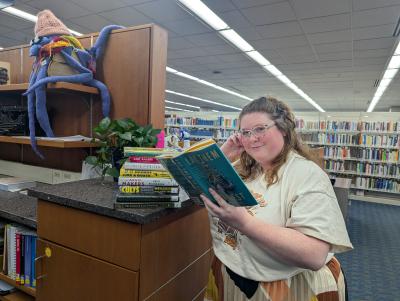
What's on Circulation's Library Assistant Emily's TBR stack?
Currently Reading
Summary
Translated by International Booker shortlistee Anton Hur, the sequel to the New York Times bestselling South Korean smash hit. Baek Sehee could never have predicted how many people I Want to Die but I Want to Eat Tteokbokki would reach across the world. A runaway international bestseller, this record of conversations with her therapist demonstrated the realities of anxiety and depression. But Baek's battle with dysthymia did not end there. In I Want to Die but I Still Want to Eat Tteokbokki , her experiences become more complex, as she vulnerably shows that striving for contentment is an ongoing journey.
TBR
Replaceable You: Adventures in Human Anatomy by Mary Roach
Summary
The body is the most complex machine in the world, and the only one for which you cannot get a replacement part from the manufacturer. For centuries, medicine has reached for what's available--sculpting noses from brass, borrowing skin from frogs and hearts from pigs, crafting eye parts from jet canopies and breasts from petroleum by-products. Today we're attempting to grow body parts from scratch using stem cells and 3D printers. How are we doing? Are we there yet?
Everything is Tuberculosis: The History and Persistence of Our Deadliest Infection by John Green
Summary
Instant #1 New York Times bestseller! * #1 Washington Post bestseller! * #1 Indie Bestseller! * USA Today Bestseller! John Green, acclaimed author and passionate advocate for global healthcare reform, tells a deeply human story illuminating the fight against the world's deadliest infectious disease. Signed edition "The real magic of Green's writing is the deeply considerate, human touch that goes into every word." - The Associated Press ″Told with the intelligence, wit, and tragedy that have become hallmarks of the author's work.... This is the story of us." -Slate "Earnest and empathetic." -The New York Times Tuberculosis has been entwined with humanity for millennia. Once romanticized as a malady of poets, today tuberculosis is seen as a disease of poverty that walks the trails of injustice and inequity we blazed for it. In 2019, author John Green met Henry Reider, a young tuberculosis patient at Lakka Government Hospital in Sierra Leone. John became fast friends with Henry, a boy with spindly legs and a big, goofy smile.
The Backyard Bird Chronicles by Amy Tan
Summary
#1 NEW YORK TIMES BESTSELLER * From the author of The Joy Luck Club comes a gorgeous and witty exploration of birding and nature. This inspiring work cultivates hope and connection, revealing the rhythms of our world and uncovering its beauty hidden in plain sight. * With a foreword by David Allen Sibley "Unexpected and spectacular" --Ann Patchett, best-selling author of These Precious Days "The drawings and essays in this book do a lot more than just describe the birds. They carry a sense of discovery through observation and drawing, suggest the layers of patterns in the natural world, and emphasize a deep personal connection between the watcher and the watched. The birds that inhabit Amy Tan's backyard seem a lot like the characters in her novels." --David Allen Sibley, from the foreword Tracking the natural beauty that surrounds us, The Backyard Bird Chronicles maps the passage of time through daily entries, thoughtful questions, and beautiful original sketches.
Scotland Yar: A History of the London Police Force's Most Infamous Murder Cases by Simon Read
Summary
A riveting true-crime history of London's first modern police force as told through its most notorious murder cases. The idea of "Scotland Yard" is steeped in atmospheric stories of foggy London streets, murder by lamplight, and fiendish killers pursued by gentleman detectives. From its establishment in 1829 through the eve of World War II, Scotland Yard--the world's first modern, professional, and centrally organized police force--set new standards for policing and investigating. Scotland Yard advanced ground-breaking use of forensics--from fingerprints to ballistics to evidence collection--made the first attempt at criminal profiling, and captivated the public on both sides of the Atlantic with feats of detective work that rivaled any fictional interpretation. Based on official case files, contemporary newspaper reporting, trial transcripts, and the first-hand accounts of the detectives on the beat, Scotland Yard tells the tales of some of history's most notorious murders--with cases that proved to be landmarks in the field of criminal inquiry.
Most Delicious Poison: The Story of Nature's Toxins-From Spices to Vices by Noah Whiteman
Summary
An evolutionary biologist tells the story of nature's toxins and why we are attracted--and addicted--to them, in this "magisterial, fascinating, and gripping tour de force" (Neil Shubin).
A deadly secret lurks within our spice racks, medicine cabinets, backyard gardens, and private stashes. Scratch beneath the surface of a coffee bean, a red pepper flake, a poppy seed, a mold spore, a foxglove leaf, a magic-mushroom cap, a marijuana bud, or an apple seed, and we find a bevy of strange chemicals. We use these to greet our days (caffeine), titillate our tongues (capsaicin), recover from surgery (opioids), cure infections (penicillin), mend our hearts (digoxin), bend our minds (psilocybin), calm our nerves (CBD), and even kill our enemies (cyanide). But why do plants and fungi produce such chemicals? And how did we come to use and abuse some of them? Based on cutting-edge science in the fields of evolution, chemistry, and neuroscience, Most Delicious Poison reveals: The origins of toxins produced by plants, mushrooms, microbes, and even some animals.
Summary
"Fans of true crime shows like CSI, NCIS, Criminal Minds, and Law and Order know that when it comes to "getting the bad guy" behind bars, your best chance of success boils down to the strength of your evidence-and the forensic science used to obtain it. Beyond the silver screen, forensic science has been used for decades to help solve even the most tough-to-crack cases. In 2018, the accused Golden State Killer, Joseph DeAngelo, was finally apprehended after a decades-long investigation thanks to a very recent technique called forensic genealogy, which has since led to the closure of hundreds of cold cases, bringing long-awaited justice to victims and families alike. But when it comes to solving these incredibly difficult cases, forensic genealogy is just the tip of the iceberg-and many readers have no idea just how far down that iceberg goes. For Laurah Norton, forensic science was always more of a passion than anything else. But after learning about a mishandled 1990s cold case involving missing twins, she was spurred to action, eventually creating a massively popular podcast and building a platform that helped bring widespread attention and resources to the case. LAY THEM TO REST builds on Laurahs fascination with these investigations, introducing readers to the history and evolution of forensic science, from the death masks used in Ancient Rome to the 3-D facial reconstruction technology used today.
The Voices of Nature: How and Why Animals Communicate by Nicolas Mathevon
Summary
Songs, barks, roars, hoots, squeals, and growls: exploring the mysteries of how animals communicate by sound What is the meaning of a bird's song, a baboon's bark, an owl's hoot, or a dolphin's clicks? In The Voices of Nature , Nicolas Mathevon explores the mysteries of animal sound. Putting readers in the middle of animal soundscapes that range from the steamy heat of the Amazon jungle to the icy terrain of the Arctic, Mathevon reveals the amazing variety of animal vocalizations. He describes how animals use sound to express emotion, to choose a mate, to trick others, to mark their territory, to call for help, and much more. What may seem like random chirps, squawks, and cries are actually signals that, like our human words, allow animals to carry on conversations with others.
Summary
A Pulitzer Prize finalist's bizarre journalistic journey through the world of fringe medicine, filled with leeches, baking soda IVs, and, according to at least one person, zombies. It's no secret that American health care has become too costly and politicized to help everyone. So where do you turn if you can't afford doctors, or don't trust them? In this book, Matthew Hongoltz-Hetling examines the growing universe of non-traditional treatments -- including some that are really non-traditional. With costs skyrocketing and anti-science sentiment spreading, the so-called "medical freedom" movement has grown. Now it faces its greatest challenge: going mainstream. In these pages you'll meet medical freedom advocates including an international leech smuggler, a gold miner-turned health drink salesman who may or may not be from the Andromeda galaxy, and a man who says he can turn people into zombies with aerosol spray.
Tasting History: Explore the Past Through 4,000 Years of Recipes by Max Miller
Summary
NEW YORK TIMES BESTSELLER Begin your very own food journey through the centuries and around the world with the first cookbook from the beloved YouTube channel Tasting History with Max Miller. What began as a passion project when Max Miller was furloughed during Covid-19 has become a viral YouTube sensation. The Tasting History with Max Miller channel has thrilled food enthusiasts and history buffs alike as Miller recreates a dish from the past, often using historical recipes from vintage texts, but updated for modern kitchens as he tells stories behind the cuisine and culture. From ancient Rome to Ming China to medieval Europe and beyond, Miller has collected the best-loved recipes from around the world and has shared them with his fans. Now, with beautiful photographs portraying the dishes and historical artwork throughout, Tasting History compiles over sixty dishes such as: Tuh'u: a red beet stew with leeks dating back to 1740 BC Globi: deep-fried cheese balls with honey and poppy seeds Soul Cakes: yeasted buns with currants from circa 1600 Pumpkin Tourte: a crustless pumpkin cheesecake with cinnamon and sugar on top from 1570 And much more. Including the original recipe and Miller's modern recreation, this cookbook is a must-have for any avid cook or history fan looking to experience delicious recipes from the past.
Summary
The Angel Makers is a true-crime story like no other--a 1920s midwife who may have been the century's most prolific killer leading a murder ring of women responsible for the deaths of at least 160 men. The horror occurred in a rustic farming enclave in modern-day Hungary. To look at the unlikely lineup of murderesses--village wives, mothers, and daughters--was to come to the shocking realization that this could have happened anywhere, and to anyone. At the center of it all was a sharp-minded village midwife, a "smiling Buddha" known as Auntie Suzy, who distilled arsenic from flypaper and distributed it to the women of Nagyrév. "Why are you bothering with him?" Auntie Suzy would ask, as she produced an arsenic-filled vial from her apron pocket. In the beginning, a great many used the deadly solution to finally be free of cruel and abusive spouses.
A Taste for Poison: Eleven Deadly Molecules and the Killers Who Used Them by Neil Bradbury
Summary
"A fascinating tale of poisons and poisonous deeds which both educates and entertains." --Kathy Reichs A brilliant blend of science and crime, A TASTE FOR POISON reveals how eleven notorious poisons affect the body--through the murders in which they were used. As any reader of murder mysteries can tell you, poison is one of the most enduring--and popular--weapons of choice for a scheming murderer. It can be slipped into a drink, smeared onto the tip of an arrow or the handle of a door, even filtered through the air we breathe. But how exactly do these poisons work to break our bodies down, and what can we learn from the damage they inflict?
The Genome Odyssey: Medical Mysteries and the Incredible Quest to Solve Them by Euan A. Ashley
Summary
In The Genome Odyssey , Dr. Euan Ashley, Stanford professor of medicine and genetics, brings the breakthroughs of precision medicine to vivid life through the real diagnostic journeys of his patients and the tireless efforts of his fellow doctors and scientists as they hunt to prevent, predict, and beat disease. Since the Human Genome Project was completed in 2003, the price of genome sequencing has dropped at a staggering rate. It's as if the price of a Ferrari went from $350,000 to a mere forty cents. Through breakthroughs made by Dr. Ashley's team at Stanford and other dedicated groups around the world, analyzing the human genome has decreased from a heroic multibillion dollar effort to a single clinical test costing less than $1,000.
Summary
"The delicious distraction we need these days." -- The New York Times Whether you need a distraction, a treat, or just a break from your responsibilities, beloved blogger Erin Gardner's enticing collection of 100 recipes is here to provide a delicious diversion. Sometimes you need to take a mini vacation from the demands of daily life, and the kitchen is the best space for it. How can you return those emails when there's dough on your hands? It would be counterproductive to handle clean laundry after dipping chocolates all afternoon, right? Whether you're avoiding work, the news, or just trying to keep your hands busy, baking offers the perfect escape. Pastry chef and beloved blogger Erin Gardner provides the ultimate guide to procrastibaking with pride and purpose in this inspired collection of 100 recipes, from easy one-hour projects to weekend affairs.
Summary
An exciting and accessible new view of the evolution of human and animal life on Earth. From the author of national bestseller, Your Inner Fish , this extraordinary journey of discovery spans centuries, as explorers and scientists seek to understand the origins of life's immense diversity. "Fossils, DNA, scientists with a penchant for suits of armor--what's not to love?"-- BBC Wildlife Magazine Over billions of years, ancient fish evolved to walk on land, reptiles transformed into birds that fly, and apelike primates evolved into humans that walk on two legs, talk, and write. For more than a century, paleontologists have traveled the globe to find fossils that show how such changes have happened. We have now arrived at a remarkable moment--prehistoric fossils coupled with new DNA technology have given us the tools to answer some of the basic questions of our existence: How do big changes in evolution happen? Is our presence on Earth the product of mere chance? This new science reveals a multibillion-year evolutionary history filled with twists and turns, trial and error, accident and invention. In Some Assembly Required, Neil Shubin takes readers on a journey of discovery spanning centuries, as explorers and scientists seek to understand the origins of life's immense diversity.
Summary
A captivating blend of history, women in science, and true crime, 18 Tiny Deaths tells the story of how one woman changed the face of forensics forever.
Frances Glessner Lee, born a socialite to a wealthy and influential Chicago family in the 1870s, was never meant to have a career, let alone one steeped in death and depravity.
Yet she developed a fascination with the investigation of violent crimes, and made it her life's work. Best known for creating the Nutshell Studies of Unexplained Death, a series of dollhouses that appear charming--until you notice the macabre little details: an overturned chair, or a blood-spattered comforter. And then, of course, there are the bodies--splayed out on the floor, draped over chairs--clothed in garments that Lee lovingly knit with sewing pins.
Why You Like It: The Science and Culture of Musical Taste by Nolan Gasser
Summary
From the chief architect of the Pandora Radio's Music Genome Project comes a definitive and groundbreaking examination of why we respond to music the way we do. Everyone loves music. But what is it that makes music so universally beloved and have such a powerful effect on us? In this sweeping and authoritative book, Dr. Nolan Gasser--a composer, pianist, and musicologist, and the chief architect of the Music Genome Project, which powers Pandora Radio--breaks down what musical taste is, where it comes from, and what our favorite songs say about us. Dr. Gasser delves into the science, psychology, and sociology that explains why humans love music so much; how our brains process music; and why you may love Queen but your best friend loves Kiss. He sheds light on why babies can clap along to rhythmic patterns and reveals the reason behind why different cultures around the globe identify the same kinds of music as happy, sad, or scary. Using easy-to-follow notated musical scores, Dr. Gasser teaches music fans how to become engaged listeners and provides them with the tools to enhance their musical preferences.
Liquid Rules: The Delightful and Dangerous Substances That Flow Through Our Lives by Mark Miodownik
Summary
Sometimes explosive, often delicious, occasionally poisonous, and always fascinating: the New York Times bestselling author of Stuff Matters offers an "entertaining discussion of the various ways our lives are enriched by fluids" (The Wall Street Journal). We know that we need water to survive, and that, for some of us, a cup of coffee or a glass of wine can feel just as vital. But do we really understand how much we rely on liquids, or their destructive power? Set on one of the author's transatlantic flights, Liquid Rules offers readers a tour of these formless substances, told through the language of molecules, droplets, heartbeats, and ocean waves. We encounter fluids within the plane--from hand soap to liquid crystal display screens--and without: in the volcanoes of Iceland, the frozen expanse of Greenland, and the marvelous California coastline. We come to see liquids with wonder and fascination, and to understand their potential for death and destruction. Just as in his bestselling, award-winning Stuff Matters, Mark Miodownik's unique brand of scientific storytelling brings his subject to life in ways that will inform and amuse science buffs and lay readers alike.
Summary
A New York Times Notable Book From Pulitzer Prize winner and New York Times -bestselling author Deborah Blum, the dramatic true story of how food was made safe in the United States and the heroes, led by the inimitable Dr. Harvey Washington Wiley, who fought for change By the end of nineteenth century, food was dangerous. Lethal, even. "Milk" might contain formaldehyde, most often used to embalm corpses. Decaying meat was preserved with both salicylic acid, a pharmaceutical chemical, and borax, a compound first identified as a cleaning product. This was not by accident; food manufacturers had rushed to embrace the rise of industrial chemistry, and were knowingly selling harmful products. Unchecked by government regulation, basic safety, or even labelling requirements, they put profit before the health of their customers. By some estimates, in New York City alone, thousands of children were killed by "embalmed milk" every year. Citizens--activists, journalists, scientists, and women's groups--began agitating for change. But even as protective measures were enacted in Europe, American corporations blocked even modest regulations. Then, in 1883, Dr. Harvey Washington Wiley, a chemistry professor from Purdue University, was named chief chemist of the agriculture department, and the agency began methodically investigating food and drink fraud, even conducting shocking human tests on groups of young men who came to be known as, "The Poison Squad."
Lady Killers: Deadly Women Throughout History by Tori Telfer
Summary
Inspired by author Tori Telfer's Jezebel column "Lady Killers," this thrilling and entertaining compendium investigates female serial killers and their crimes through the ages.
When you think of serial killers throughout history, the names that come to mind are ones like Jack the Ripper, John Wayne Gacy, and Ted Bundy. But what about Tillie Klimek, Moulay Hassan, Kate Bender? The narrative we're comfortable with is the one where women are the victims of violent crime, not the perpetrators. In fact, serial killers are thought to be so universally, overwhelmingly male that in 1998, FBI profiler Roy Hazelwood infamously declared in a homicide conference, "There are no female serial killers."
Rest is Noise: Listening to the Twentieth Century by Alex Ross
Summary
The scandal over modern music has not died down. While paintings by Pablo Picasso and Jackson Pollock sell for a hundred million dollars or more, shocking musical works from Stravinsky's Rite of Spring onward still send ripples of unease through audiences. At the same time, the influence of modern music can be felt everywhere. Avant-garde sounds populate the soundtracks of Hollywood thrillers. Minimalist music has had a huge effect on rock, pop, and dance music from the Velvet Underground onward. Alex Ross, the brilliant music critic for The New Yorker , shines a bright light on this secret world, and shows how it has pervaded every corner of twentieth century life.
The Secret of Chimneys & The Seven Dials Mystery by Agatha Christie
Summary
What is The Secret of Chimneys? A young drifter finds out when a favor for a friend pulls him into the heart of a deadly conspiracy in this captivating classic from Agatha Christie. Little did Anthony Cade suspect that an errand for a friend would place him at the center of a deadly conspiracy.
The Murder of Roger Ackroyd: A Hercule Poirot Mystery: Agatha Christie
Summary
The death of a wealthy widow is believed to be an accident until her future husband is killed. The police bring in Hercule Poirot to help with the investigation.